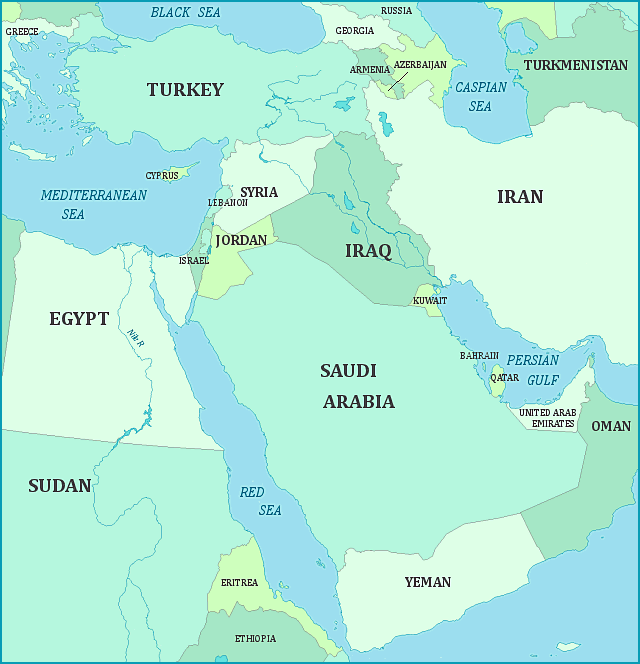
I initially learned about what I thought was the Middle East the same way I learned about most things as a child; through books. I read The Breadwinner by Debra Ellis when I was 9 or 10 and then The Kite Runner and A Thousand Splendid Suns for high school English class. These books focused mainly on life under the Taliban in Afghanistan. On a subconscious level, they formed most of my perceptions of the Middle East, and yet Afghanistan isn't even considered to be a part of the geopolitical region. This is a massive issue! Most average people probably don't even know what countries the Middle East is composed of and to be blunt, they probably don't even care. This is a region with diverse histories and cultures and it deserves better from us, as global citizens.
I believe we, as a society, have come to accept the bare minimum as sufficient when it comes to dealing with people and cultures that seem different from ourselves. By this I mean in day to day life we gloss over the Middle East and the damage the west has caused there. Children learn about the Ancient Egyptians but are never told about the 2013 coup d'etat and subsequent unrest. Our grade 10 Canadian History course, which focuses predominantly on World War II and the Holocaust, does not acknowledge the mass disruption caused by the establishment of Israel in Palestinian territory. Furthermore, our grade 11 World Religions course provides ample opportunity to discuss the Middle East as it is where three of the major world religions were founded and intersect. And yet, the current state of the geopolitical region is not mentioned at all in the course outside of the sacred pilgrimage to Mecca. It is with these holes in our education that we form stereotypes and prejudices about the Middle East and the people who come from there.
We must actively unlearn our prejudices concerning the Middle East because we owe it to the people from there, but we also owe it to ourselves. Having irrational fears about an entire region of the globe is draining and toxic. The first active step I took in unlearning my preconceived notions about the Middle East was when I traveled to Egypt for 9 days in 2017. I wanted to go to Egypt because I had learned all about the Ancient Egyptians during my first year of university and so, I wanted to see the pyramids. I actually ended up seeing a lot more than the pyramids. I saw a magnitude of poverty I had never seen in Canada before. Children would come up to me on the streets begging for food or money. It impacted me in ways I didn't even realize at the time. And Egypt isn't even within the 20 poorest countries in the world. It's hard for me to comprehend what the poorest of the poor would even look like. I saw buildings that seemed to be crumbling and severely congested streets. But I also saw so much good. So many individual people did everything in their power to ensure that I, a white traveler from Canada, had the best possible time. Bellboys in hotels would carry my suitcase up flights and flights of stairs. A Nubian family took me and my entire tour group in to their home for a delicious meal. Restaurant workers cooked and served us food as they were fasting during Ramadan. And my tour guide showed some of the greatest hospitality I have ever experienced. The truth is, these people just want to make an honest living and tourism is a great means to do so. When the world opens back up again, this is one way we can start the unlearning process. Go and experience authentic cultures and people. There are, however, things we can do now too and what we do now may have an even greater impact.


So what is there to do now, in the middle of a global pandemic to help the Middle East? Read and research. Understand that this diverse region is not just desert and it's not full of terrorists. It is not purely backward and misogynistic in its customs. It is through these misunderstandings and misinterpretations that Islamophobia is spread throughout the west. The truth is, the vast majority of the people in the Middle East generally and Muslims specifically are peaceful. What is more, violence is not inevitable there, no matter what western media outlets will have you believe.
The next section of this post is going to discuss specific countries you've probably heard in the news a lot lately. These are the ones that especially need our support right now. We cannot continue to turn a blind eye, these people deserve better.
Syria 
Syria has continuously been in the news since 2011 and yet I still encounter so many people who don't understand what has happened there.
Syria functioned as a colony of France following World War II and became an independent state on 17 April 1946. However, it was ruled by a dictator, Hafez al-Assad from March 1971 to 2000. Then, his son, Bashar al-Assad was "elected" president and remains so to this day. Simply put, the people of Syria were not happy with their rulers. They were under emergency rule from 1963 until 2011 which meant public gatherings of more than five people were banned... for close to 50 years! Additionally, the most intense drought ever recorded in Syria occurred from 2006-2011. This drought was due to anthropocentric climate change and resulted in the mass migration of rural citizens to urban centers as well as increased food prices. Then, in March 2011, pro-democracy protests erupted across the country following the Arab Spring (a series of anti-government protests and uprisings beginning in Tunisia). These protests were fueled by the fact that the country was mostly made up of Sunni Muslims, yet the government was dominated by the Shia Alawite Sect. Obviously, the people did not feel that their government adequately represented them, so they protested.
By September 2011, organized rebel militias were regularly engaging in combat with government troops. This fighting continues today as Syria continues to be torn apart by civil war. Currently, it is estimated that 13.1 million Syrians need humanitarian assistance. There are more than 5.6 million refugees that have fled the country, most have which have relocated to Turkey, Lebanon and Jordan. More than 6.1 million more people are displaced within Syria. Estimates place deaths in Syria since 2011 at more than 400,000. If you value basic human safety and human life, then you should care about this! Regular citizens like you and I have lost everything for standing up for what they believe in.
Despite how bad its gotten in Syria, it could still get worse for many Syrians. Refugees are facing increasing hostilities in countries where they have resettled. Additionally, the current regime requires that returnees sign a "reconciliation agreement" which states that they left the country illegally. This "agreement" therefore constitutes a confession of a legal violation in a dictatorship. COVID-19 is also expected to cause cuts for humanitarian aid to Syria due to economic difficulties caused by the pandemic. We have to understand that the people of Syria did not chose this and they are merely wishing to seek better elected officials and institutions. Please, keep Syria in your heart as it continues to be ravaged by war, dictatorship and a pandemic
Palestine
The Palestinian Territories include parts of modern-day Israel, the Gaza Strip and the West Bank. Like Syria, it has repeatedly been in the news for many years. This is mainly because it has been the object of conflicting Jewish and Arabic national movements. This directly relates to the World Religions course I discussed earlier. Both religious groups claim the same small territory of land to be rightfully theirs.
Palestine became a British mandate following World War II. Of course, the end of the war also brought light to the mass slaughter of European Jews. It is within this context that the modern-day state of Israel was created. Millions of Jews had been slaughtered in Europe, so wasn't it within the rights of those who survived to demand a Jewish homeland? Maybe it was and maybe it wasn't but the reality is there were already millions of people living there. Despite the preexisting society present in Palestine, millions of immigrants have arrived to the area west of the Jordan River from Europe, North America and elsewhere since 1948. I think the most important point to make regarding the Israeli-Palestinian debate is that solving the problem of European Jewry following the Holocaust should not have been achieved by inflicting injustice on Palestinian Arabs. Read that last sentence again.
Currently, the Gaza Strip has an unemployment rate of 47%. The Arab majority of the West Bank and Gaza Strip fear annexation by Israel and oppose Israeli control. There is a widespread fear that a third intifada, or popular uprising could break out and escalate into large-scale violence. The reality is that for decades Israel has been backed by white western democracies, predominantly the United States, while we have allowed Palestinians to suffer. The United States claims to be pro-democracy yet they align themselves with a nation that chooses to exercise complete control over another group of people. Palestinians deserve their own sovereign state and who knows, maybe in my life time that will be possible. Whether you are Jewish, Christian, Muslim, Hindi, Atheist or any other religion, it is time we realize what has really happened in Palestine since the end of World War II and hopefully the wrongs that have been done can be fixed.
Yemen
Yemen has been appearing lately with increasing frequency. It is one of the Arab world's poorest countries. Like Syria, its civil war has roots in the failure of a political transition following the Arab Spring in the early 2010's. Abdrabbuh Mansour Hadi became president in 2011 but the Houthis, an Islamic political and armed movement, quickly took advantage of his weakness. They soon took control of the northern provinces of the country. Many Yemenis supported the Houthis, however other militant groups, including al-Qaeda, seized territory in the south while carrying out deadly attacks. Furthermore, the Saudi-led blockade of Yemen led to substantial increases in food and fuel prices at the same time. Essentially, this conflict is seen as part of a regional power struggle between Shia-ruled Iran and Sunni-ruled Saudi Arabia.
Yemen is currently experiencing the world's worst humanitarian crisis EVER. Estimates put the death toll of the war at more than 100,000. Currently, 80% of the population or 24 million people need humanitarian assistance and protection. This civil war has also displaced more than 3.65 million people. The chaos caused by the civil war in Yemen is only heightened by the largest cholera outbreak ever recorded. There have been more than 2.2 million suspected cases and 3,895 deaths since October 2016. And now, medics must also deal with COVID-19, which is spreading rapidly while only half of the nation's health facilities are functioning, many of which lack basic equipment such as masks and gloves. The spread of disease is coupled with extreme weather events. Yemen has experienced months of heavy rain, flooding and storms since mid April. This has not only left many homeless and more prone to injury, it has also caused the UNESCO Old Sanaa house to collapse. Again, if you care about the plight of humanity in the slightest, you must care about what is happening in Yemen. These people need us now more than ever. We cannot continue to sit back and let innocent people suffer for things not caused by their own doing. If you can, donate to reputable campaigns that are actually making a difference in Yemen.
Lebanon
Lebanon is the site of some of the oldest human settlements in the world such as Tyre and Byblos. Like many other Middle Eastern countries, it became a French mandate in 1920 and received independence in 1943. The nation was engulfed in civil war caused mainly by a growing sense of insecurity from 1975 to 1990. The war catapulted large Lebanese migrations abroad to the United States, Europe, Latin America, Australia and other parts of the Middle East. Shortly after the civil war, the Second Lebanon War occurred in 2006. This consisted of a month-long conflict between Israeli and Hezbollah forces. Lebanon and Israel are still at war.
I'm assuming everyone has heard about the recent explosion in Beirut and its catastrophic consequences. On 4 August 2020 the explosion in Beirut caused at least 181 deaths and 6,000 injuries as well as around $15 billion USD in damages. The explosion also left an estimated 300,000 people homeless. The Beirut explosion is considered one of the most powerful non-nuclear explosions in history but what caused such a devastating blow? Evidence shows that 2,750 tonnes of ammonium nitrate had been improperly stored in a warehouse on the port for 6 years. In the days following the explosion, protests against the government for their failure to prevent the disaster became widespread across the country. Prime Minister Hassan Diab and his cabinet resigned on 10 August 2020 due to mounting political pressure.
Lebanon's economy was in crisis prior to the explosion, with more than 50% of the population living in poverty. It also hosts the largest numbers of refugees in the world, many from neighboring Syria. They are also dealing with the COVID-19 pandemic alongside everything else. This nation is facing so many challenges right now and we should be prepared to help.
It is within my understanding of compassion and empathy that we owe the Middle East a lot. The very least we can do is educate ourselves about the issues there. The struggles of each of the nations discussed above and the region in general are caused at least partly by colonialism. Relatively speaking, these countries are still newly independent. However, the west has the capacity to help them through any means necessary so their citizens can not only survive by thrive. The new independence within the Middle East is only exacerbated by climate change. The floods in Yemen and the drought in Syria prove that climate change disproportionately impacts the poor. Caring about humanity, therefore, is directly related to caring about the environment and climate change. We cannot waste anymore time. Globalization has made the world smaller and that means we now know more than ever. It is not hard to see how our overproduction of CO2 in the west is directly impacting citizens in the Middle East. We should use this knowledge to seek real and lasting change.
Sources
Comments
Post a Comment